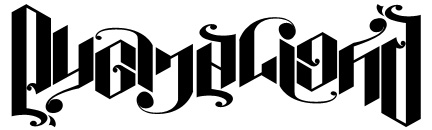
Years ago, my dad showed me an article in the Smithsonian magazine on JSG Boggs, a guy who drew his own money for fun & profit. Somehow, through this article, I managed to get on ambigrams, or word graphics that read in interesting & peculiar ways upside down & right ways up. In this case, the ambigram reads "SIGHTLAB" either way, but (f'rinstance) my ambigram (at least one version anyway) for Raub Roy's outstanding Hora Flora project reads "HORA" one way & "FLORA" the other. Derin Brown's great "Trick or Treat" program(me) used an amigram of Trick & Treat to dupe participants into pre-arranged tricks & treats. Regardless, a flip through my sketchbooks from the original exploritory period (1987 or so) shows a lot of fruitless mumblings. At some point, I picked up a book by John Langdon called "Worldplay", which I thought would be a useful volume on ambigram thinking. Not so much, but it is interesting. Later, a coworker gave me a copy of Dan Brown's "Angels & Demons" because I was going to Italy for a month & I love Bernini. There, again, were these ambigrams (as well as Brown's hero character, Robert Langdon, named lovingly after John Langdon), held on a pedestal as some sort of Illuminati secret magic writing. I took that as a direct challenge: There's noting inherently special about ambigrams. They require little more than a love for typography to do, and present a really great graphic design problem: you need to create a legible character that totally sells a letter in one direction, and another letter in another. I've found that some come easy & some are impossible. They all start out impossible. But if you start out with a goal word or words, and write that/those word/words right side up, upside-down, imposed over one another & in variations of upper & lowercase, eventually the idea will click, or it will become clearly impossible. There's no middle ground. Either it'll work, or it wont without re-strategizing. The first glimmer of success looks awful, and can be polished into a jewel with enough patience. The SIGHTLAB example is about 60% successful, but I like where it's at.
To wit
: